Publication policy
A double-blind peer review process
The Journal of Trade Science has adopted a double-blind peer review process based on the standard of international science journal.
After articles are accepted in the process of reviewing, the paper is automatically given a code number and classified by the research topic according to the Journal of Economic Literature (JEL) before being transferred to the reviewers (the reviewers could select some important criteria including: appropriate specialization and level of criticism in the research topic). During the review process, the reviewer may not know any information of the authors and vice versa.
The reviewing process consists of three basic stages: (1) Stage 1 - Preliminary estimate; (2) Stage 2 - Peer reviewing; and (3) Stage 3 – Approval. All stages in the review process of Journal would be displayed on the online posting system so that the author can keep track of the process of the article.
The review and publication process of the Journal could be described as follows:
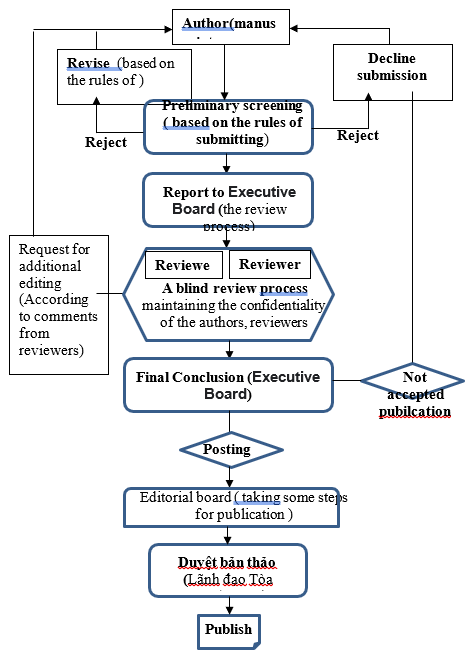
Approval of the manuscript (Executive Board)
* Stage 1 – Preliminary estimate
After the author logins on the online system by the personal account and sends the manuscript successfully, the online recipient system would automatically confirm its arrival by email to inform the status of the manuscript
Simultaneously, the article would be processed through 2 stages: (1) Plagiarism checking and similarity checking (Turnitin); and (2) Checking the satisfaction of the article's form to the Regulation on the structure and form of scientific articles submitted to The Journal of Trade Science. Preliminary results could be:
C Preliminary Acceptance: If The paper meets sufficient criteria, the author would receive a response letter to inform transferring the review process of the Journal.
C Preliminary Rejection: If the article falls short of criteria, the author would receive a response letter to inform the next stages of the article: (1) the rejection of receiving the manuscript or (2) Revise and resubmission
The Journal of Trade Science would process and inform its author(s) of results of this preliminary estimate within 7 working days after receiving the paper.
* Stage 2 - Review
After the first stage, Editorial Board would select and send to the reviewers: Reviewer 1 and Reviewer 2. Reviewers would work seriously to give comments for the manuscript based on the detail criteria. The overall content of review process would focus on 5 contents as follows:
1. The significance of the thesis and New contributions of the thesis
2. Rationale for the study
3. Research model and/ or content of research topic used by author(s),
4. Research methodology
5. Scientific criticism and reliability of research results.
6. Implications/solutions to the research problem
7. Logical content, style and format of scientific articles
The conclusion of the review period could be :
(1) Rejection (The reasons explained on the report)
(2) Publication acceptance
(3) Revisions required (explaining the content to be edited, Spontaneously, note for Editorial Board whether the reviewer needs to review the revised article)
The author receives the comment of the reviewers so the author should revise carefully and promptly so that the reviewers consider.
The time for reviewers to read and send the comments: From 1 to 14 days, from the date of …… The Journal sends each reviewers (On the special circumstances, the Journal can request the reviewer to provide comments and read during faster and slower period)
The author revise and send the manuscript again: From 1 to 7 days, from the date of….The Journal sends comments for the authors ( On the special circumstances, the Journal can request the reviewer to provide comments and read during faster and slower period).
The period to finish the review process: From 1 to 3 months, from the date of….The Journal informs to receive in the review process ( The period can last up to 1 month in case the reviewer/author's request for an extension of time is accepted by the Editor-in-Chief)
* Stage 3 – Approvals
The Editor-in-Chief is the last person to make the final decision (the paper accepted or rejected for publication) when:
(1) The reviewer agrees: The author(s) will be notified of this decision If the editorial leaders agree with reviewers and the paper is included in the waiting list. Otherwise, another referee will be asked to settle the disagreement.
(2) The reviewer disagrees: This circumstances will be implemented as the second stage. The period of the approval would last from 1 to 9 months after the article is sent to review to have a final decision and inform the results to the author (s).
Publishing Policy
The paper, after its being accepted for publication, is sent to copyeditors who may make adjustments to its style, presentation, and formatting. Author(s) can be required to help with this process and is properly notified of any major changes.
- Step 1 – Copyediting: Necessary changes or adjustments are made to the format, style, language, and presentation according to the title of the Journal.
- Step 2 – Manuscript presentation: Copyeditors adjust format and layout of the paper in its electronic version, and also check for any possible mistakes and plagiarism before saving it in relevant folders for future consultation. The technician designs and presents the article according to the standard format of the Journal and then prints out.
- Step 3 – Proof reading: The paper is printed for proof reading by copyeditors and secretary before being sent to the layout technician. This copy is called the first-round proof. It is then reviewed carefully by copyeditors and secretary. All necessary information about the paper should be in place now, such as article history, abstract and keywords in English. After the review, the first-round proof is sent back to layout technician.
- Step 4 – Review of the second-round proof: layout technician makes corrections as instructed and produces the second-round proof. Copyeditors compare such with the first proof to detect possible mistakes. The proof is checked again by the secretary before it is returned to the layout technician.
- Step 5 – Decision on table of contents of the new journal issue: After all articles are well reviewed and arranged, the secretary draft the table of contents and all articles included in the issue are printed and paginated (this copy is called third-round proof) before being submitted to editorial leaders and secretary for approval. Last rearrangement and adjustments are made if need be before relevant documents are sent to the printing house.
- Step 6 – Final check: After the executive board agrees, The third-round proof would send to the layout technician to then turn it into pdf format and have it sent to the printing house house along with the cover design approved by the Journal. At the same time, final proof in .doc/docx is sent to JTS administrator for saving.
Duration for copyeditors to complete steps from 2 to 5 is at most two working days each. Duration for layout techinician to carry out steps from 4 to 7 is at most one working day each. Duration for the Stage 4 (preparations for publishing) varies from 10 to 15 working days, starting from reception of the accepted articles.